

OPINION: Belonging Shouldn't Require an Application: The Issue with "Club Culture" at Elite Universities
By: Hannah Corwin

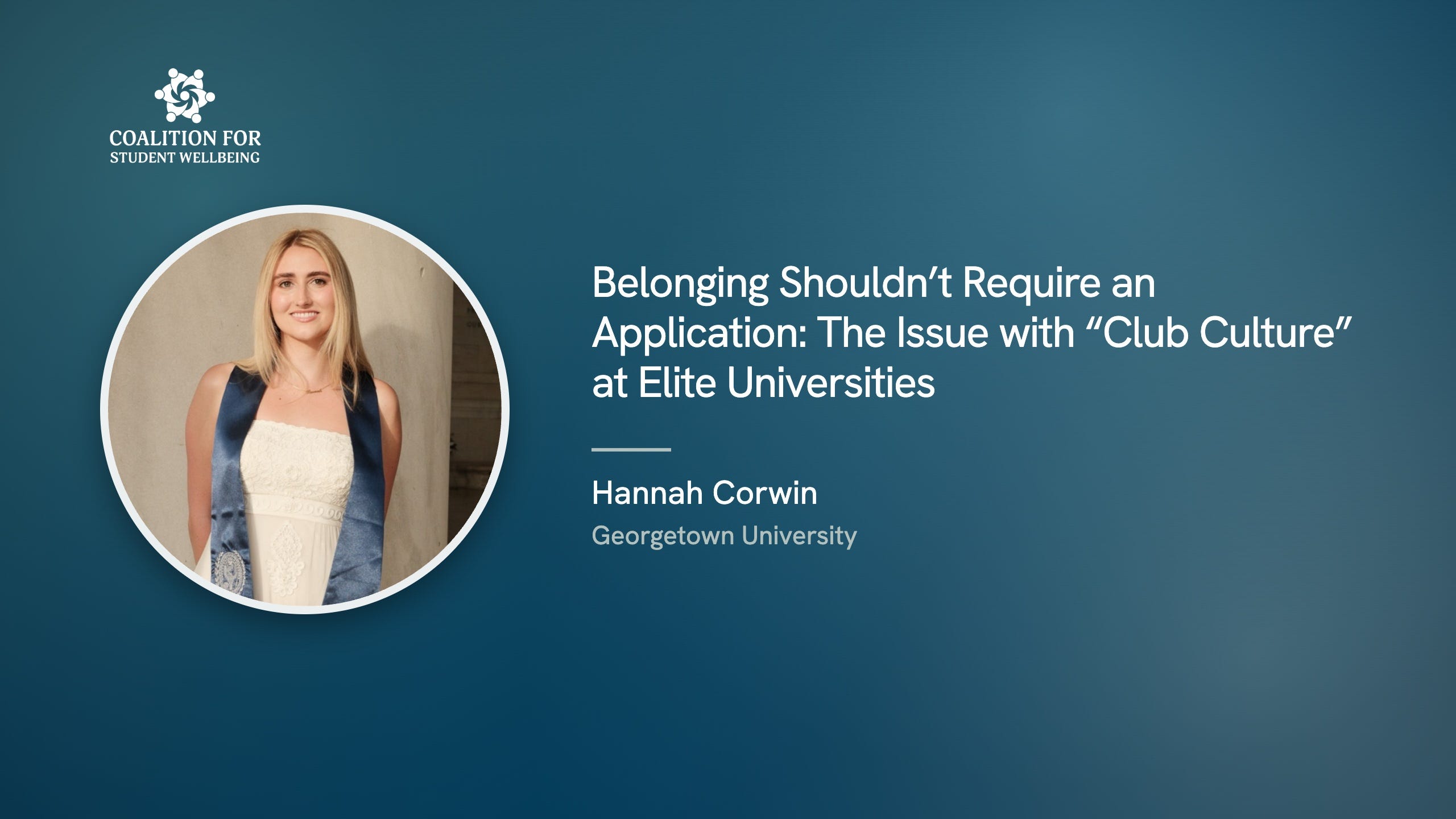
After nearly two years of standardized testing, endless supplemental essay drafts, and conversations with my family about what I imagined college would look like for me, I arrived at the Hilltop. Growing up, as the daughter of Georgetown graduates, I heard endless stories about the university’s profound sense of inclusion, excitement, and camaraderie. I was eager to follow in my parents’ footsteps.
What I did not realize was how much the school’s culture had changed in the past thirty years. The university that had fostered an enduring friendship between my mom and her random roommate from freshman year, a girl who had never left the state of Nebraska before going to college, had transformed into a place where social life seemed dominated by competitive pre-professional clubs and exclusive circles.
As I wandered through the endless rows of clubs trying to convince wide-eyed freshmen to join their student-run organization for the upcoming semester at Georgetown’s annual club fair, I was unaware of the significance of what I was choosing not to apply to. I didn’t see the point in joining a club that didn’t align with my interests or career plans and found it laughable that, after a grueling application process just to get into Georgetown, we were being asked to do the same upon our arrival to join “elite” campus groups. I didn’t follow the herd, instead choosing to spend time getting to know new classmates at dingy nightclubs in DC, while others prepared for coffee chats and club interviews.
Weeks later, I realized what I had missed. As acceptances rolled out, many students were welcomed into established communities that instantly provided friendships, mentorship, and structure. Unknown to me, at Georgetown, the social ecosystem that Greek life provides at many other universities throughout the country was embodied by pre-professional organizations. My friends were suddenly busy with trainings, initiations, and formals. It seemed like I made an irreversible mistake.
By the spring, I tried to fix what I felt like I had screwed up — but it was already too late. I applied to a few finance clubs with the guidance of my friends who were already in them and didn’t get into a single one. I felt defeated. Despite efforts to find my “people” and my “thing,” I felt like everyone else around me had access to groups that gave them both, while I was still searching.
It wasn’t until the end of the semester that a beacon that would steer me out of the fog appeared — a small club called Project Lighthouse. I was instantly drawn to it. Though the organization was still rebuilding after the COVID-19 pandemic and could not promise social events or career networks like other clubs, it aligned with something I genuinely cared about: peer support.
So, for the next three years, I spent multiple hours every week helping Project Lighthouse get back on its feet alongside students and faculty committed to building a peer-to-peer support network on campus. Now passing leadership on to another set of dedicated Hoyas, while the organization has come a long way in the past few years, it still has room to grow — and its journey is full of important lessons to be taken away about the relationship between universities and the wellbeing of their students.
One challenge we consistently faced was getting people to use the resource. Every day, we had students trained in peer support eagerly waiting on the other line to chat, but few students reached out — and I think the reason for this comes back to the club culture that Georgetown and many other “elite” schools possess.
In intensely career-driven environments, students become reluctant to admit — either to others or to themselves — that they are struggling. When productivity, achievement, and professional ambition are treated as the defining markers of success, vulnerability begins to feel like failure. Students forget that they are more than GPAs, internships, or future job offers. They forget that needing rest, support, or connection is normal.
But another problem is visibility.
Unlike Project Lighthouse, many pre-professional organizations are highly visible from the moment freshmen arrive on campus. Incoming students quickly learn which clubs are prestigious, which organizations dominate recruiting pipelines, and which names carry social capital. Entire generations of students have inherited these institutions’ reputations, alumni networks, and recruiting advantages.
Meanwhile, Project Lighthouse often had to fight simply to be recognized. Much of our time was spent tabling, hanging flyers, and repeatedly explaining what the organization was and why students should care. The university offers little support for our nearly $2,000 annual chatline software fee, while some consulting clubs receive thousands of dollars each semester. There is something deeply troubling about a campus where students can name twenty consulting organizations but struggle to identify a single peer-to-peer mental health resource.
So, from my experience, I think Georgetown — and schools with similar cultures — need to ask themselves difficult questions about the kinds of organizations they choose to elevate and reward, and the message that sends to students searching for connection when they first arrive on campus. Too often, universities place pre-professional clubs in the spotlight: organizations designed to produce another generation of consultants at firms like Deloitte or McKinsey & Co., reinforcing the institution’s image as a pipeline to elite corporate success.
But in doing so, universities also reveal their priorities. When clubs tied to prestige, recruiting, and institutional reputation receive disproportionate funding, visibility, and support, while student-led mental health initiatives struggle for recognition, the message becomes difficult to ignore: student wellbeing is treated as secondary to professional branding. A peer-to-peer support hotline may not improve a university’s rankings or impress recruiters, but for many students, it provides something far more valuable — a sense that their lives matter as much as their résumés.
Hannah Corwin is a recent graduate of Georgetown University and served on the Council on Student Wellbeing.