


My mom immigrated to the United States from Peru with the dream that her children would have the opportunities she never did.
Neither of my parents graduated from high school, meaning there was no blueprint for college sitting at our kitchen table growing up. There were no conversations about what to do, where to go, or how to succeed in higher education. I learned everything about the professional world by decoding the rules of a game that everybody around me already knew how to play.
For a while, I thought feeling lonely was just part of this process of growing up.
As a first-generation college student, there exists an immense pressure to appear as if you know what you are doing, while internally you are building a map every step of the way. You are required to navigate an untraversed path, not just for yourself, but for everyone watching who sacrificed their time and effort to put you there in the first place.
This pressure quickly becomes suffocating.
I would spend hours writing cold emails to professors and prospective mentors because I had no other choice. I did not have any family connections in the fields I aspired to enter. I sent dozens of emails into complete silence, refreshing my inbox, hoping to receive answers. Surrounding me were students whose parents grew up around medicine, business, or academia — kids who inherited professional networks without even realizing it. While I spent hours learning on my own, trying to understand the language of these professional spaces, I had an equally difficult undertaking to complete: convincing myself that I belonged in the places I wanted to reach.
It is not talked about enough how isolating this can feel.
Being a first-generation student creates social stressors that often remain invisible to everyone else. Financial stress is one of the most prominent issues we face. Many first-generation students balance jobs, supporting their families, providing money for relatives, and turning down unpaid internships or opportunities because they are financially unrealistic. And even for first-generation students who may not personally carry a financial burden, there often remains an intense awareness of money created by generational memories. Many grow up seeing their parents, despite having overcome financial hardship, still carry the anxieties and habits formed by it.
Then, of course, there is the guilt.
It’s the type of guilt that sinks into your chest every time you fail academically, lose motivation, or burn out — because first-generation failure does not feel individual, but generational. You are reminded of parents or grandparents who immigrated here, believing that education would sprout new lives for their children. You are reminded of their sacrifices: long hours, instability, leaving behind family and familiarity. All of a sudden, a poor exam grade or the feeling of burnout turns into a waste of everything they worked for.
I think many of us become professionals at carrying this weight invisibly.
Especially in course-rigorous academic environments, where everyone else appears certain of their ability, my confidence feels performative. I’m fearful that for many other first-generation students, there are moments where we genuinely do not feel traditionally welcomed in these kinds of environments — not because someone told us we don’t belong, but because there is an underlying sense that everyone else showed up with a guidebook we never received.
When you look around and see your family members, relatives, or cousins not pursuing higher education themselves, it becomes hard to explain the emotional reality of college to the people who know you the most — an experience that is isolating at best. Academic burnout sounds like an abstract concept to them, who understandably see education primarily as an opportunity and privilege. The anxiety gets perceived as stress you should push through. Conversations about mental health become unfamiliar and uncomfortable.
So instead, these students stay silent.
They continue to overload their schedules. They continue to say yes to everything. They continue chasing dreams and achievements while running on fumes of anxiety, imposter syndrome, and the fear of disappointing the people they love the most.
I know because I am one of them.
At a certain point, I convinced myself that if I just kept working hard, the inner feelings of inadequacy would eventually float away. More leadership. More research. More volunteering. More pressure. I was treating exhaustion as proof I earned my place — and eventually, this exhaustion caught up to me.
Despite how common these experiences and stressors are among first-generation students, many of us still feel deeply alone in them.
This is why support for first-generation students must go beyond a university’s orientation week programming, slogans, and admissions statistics. Administrations need to understand the emotional reality behind it all. This means accessible mental health support, financial aid, structures that make opportunities actually accessible, and environments where students asking for help is not a weakness.
Above all, I think that first-generation students are due the permission to be human: to admit when life is too heavy, rest without guilt, and stop believing worth is tied to productivity.
For so long, I thought that success and strength meant proving I could fight all of my battles alone. Now, I think the real strength is having a community and support system that allows me to ask for support before I break under the weight of trying to earn my spot everywhere I go.
Because as first-generation students, we already carry enough.
We should not have to carry it silently, too.
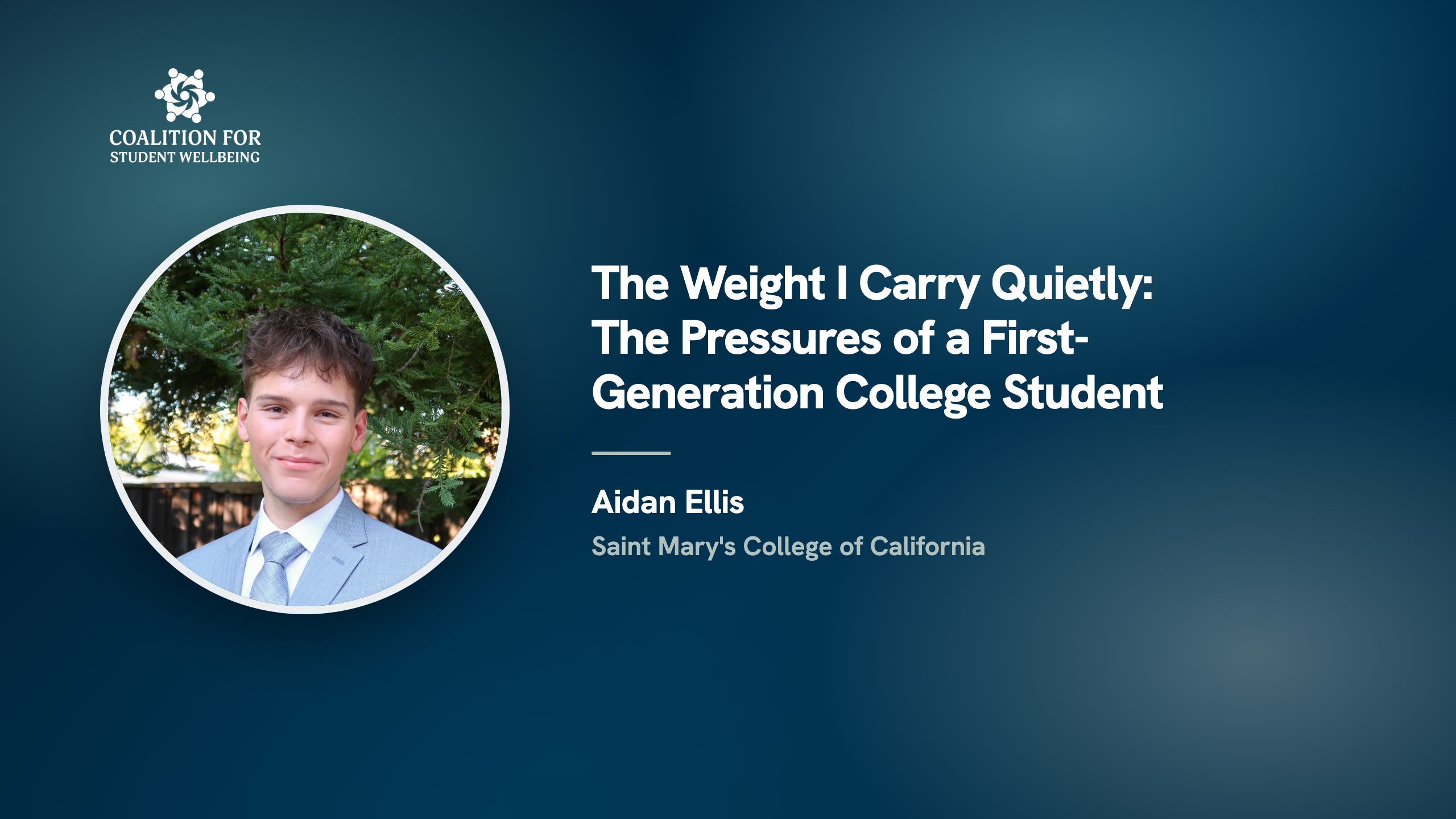
Aidan Ellis is a student at Saint Mary’s College of California majoring in Biology and Psychology. Aidan is from Pleasanton, California.